
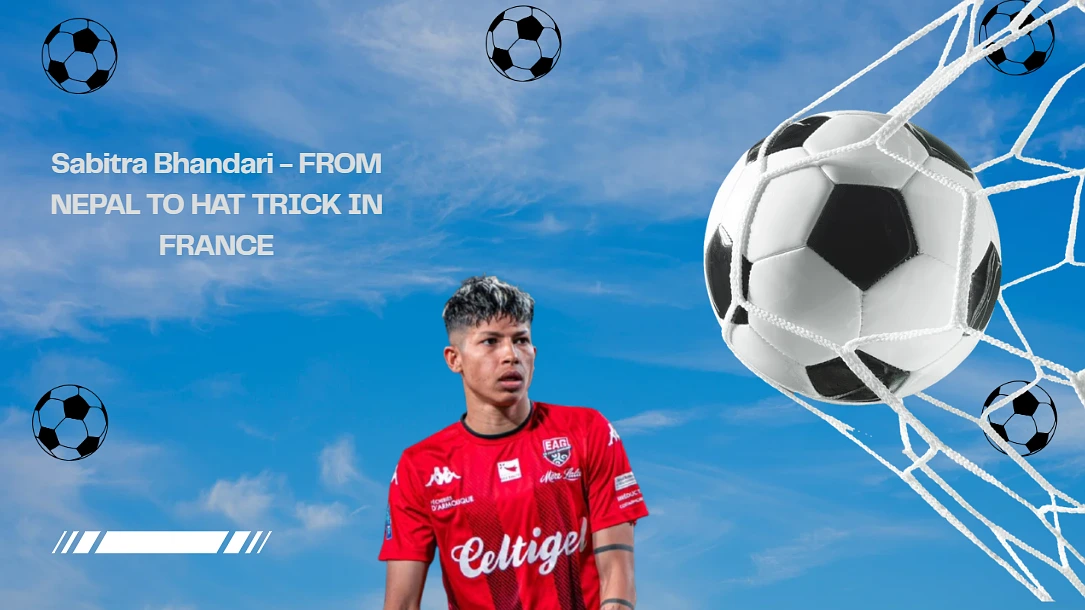
There is a footballer from Nepal who grew up in Simpani village in the Lamjung District playing barefoot with boys using a ball that was made from rolled-up socks, and last year she scored a hat-trick in the French top flight, which made her the first South Asian player in history to do that in a top-tier European league.
Her name is Sabitra Bhandari. Most people call her Samba.
68 international goals in 61 caps for Nepal. All-time highest scorer in all of Nepalese football, men or women. Captain of the national team. First Nepali ever to play and score in a European top-flight league.
And she never asked her parents for a pair of football boots growing up because she already knew the family could not afford them. She told FIFA.com that in an interview years ago and the way she said it was very matter of fact, not as a complaint but just as something that was true and did not need explaining.
She Went to Kathmandu With Rs 5,000 and Spent Rs 3,000 of That on Her First Boots
In 2014 Sabitra was 17 years old and she left Lamjung for Kathmandu with five thousand rupees in her pocket. That is roughly $38. She spent three thousand of it on a pair of football boots because she was going to try out for the Armed Police Force club and she figured showing up barefoot to a professional trial might not work even though barefoot was how she had played her entire life up to that point.
She got the contract.
Her teammates at APF gave her the nickname Samba because of how she played, something about the way she moved with the ball reminded them of Brazilian football, and the name stuck everywhere she went after that.
The part of this story that genuinely sits with you is the training commute. She used to walk for hours to get to practice because the bus cost Rs 10 and if she saved that Rs 10 she could buy a banana to eat. So she walked. For hours. To save ten rupees. For a banana.
हिम्मत गर्ने हारदैनन्। Those who have courage do not lose. That is what people say in Nepal and honestly there is no one who fits it better.
She Scored Two Minutes Into Her International Debut and Has Not Stopped Since
Her first cap for Nepal came in 2014 at the SAFF Championship against Bhutan. She came off the bench around the 86th minute as a substitute and scored two minutes later, which sealed an 8-0 victory. She told FIFA.com afterwards that she did not even expect to play that day and then suddenly she was on the pitch and then suddenly there was a goal and everything moved very fast.
From there she moved to India and won the Indian Women's League Golden Boot twice, first in 2019 with Sethu FC and then again in 2023 with Gokulam Kerala where she put 29 goals in 10 games which honestly when you hear that number you have to read it again because 29 in 10 is almost 3 goals a match and that is not normal at any level anywhere.
Somewhere between those two Golden Boot seasons she tore her ACL. Came back from that playing the same way she played before it, which if you know anything about ACL recovery for footballers you know is never guaranteed and for a lot of players it is the injury that takes the sharpness away permanently. It did not take hers.
In 2023 she spent a few months at Hapoel Ra'anana in Israel. 6 goals in 4 matches. "नेपाल की छोरी" Nepal ko chhori, daughter of Nepal, putting the ball in the net in the Middle East now too, and at that point the stats sheet had traveled far enough from Lamjung that European clubs were calling.
Guingamp, PSG, and the Hat-Trick
Guingamp in France signed her for the 2024-25 Division 1 Féminine season, same league as PSG and Lyon and Marseille.
She was their top scorer by the end of the season with 6 in 19 appearances. A Nepali striker walking into European professional football for the first time and finishing as the top scorer for the club is, if you think about how rare that transition is for any South Asian player, not a small thing at all. Most would spend the first season adjusting. She spent it scoring.
March 21, 2025. Brace against Paris Saint-Germain. Two goals. Against PSG. The girl who played with a sock ball in Simpani scored twice against a club that pays individual players more per week than her entire village earns in a year. You read a sentence like that and it sounds like a film script but it is just the match report from that day.
Then came the Saint-Étienne match and three goals in one game and with that she was the first South Asian player ever, not just Nepali but the first from all of South Asia, India, Pakistan, Bangladesh, Sri Lanka, all of it, to score a hat-trick in a top-tier European league. Nepal got there before everyone. Through a woman from a farming family who bought her first boots with money that was supposed to last her an entire move to a new city.
Wellington Phoenix and How Kathmandu Follows Her Matches at 3am
Wellington Phoenix signed her in July 2025, two-year deal, A-League Women in Australia. Fourth appearance against Sydney, two goals and an assist, first Nepali footballer to score in the A-League Women. She is 30 now and still doing this, still going places where her name means nothing to anyone in the stadium until the ball hits the net and then suddenly it does.
The thing about following Samba from Nepal is that the Wellington Phoenix schedule runs at hours that make no sense in Kathmandu. Matches kick off when it is 3am or 4am Nepali time and A-League Women's football does not get the same broadcast distribution in South Asia that the Premier League or Champions League gets. So Nepali fans following her career end up on their phones at odd hours, checking live score apps, scrolling football platforms, tracking A-League results through services like 1 x Bet Nepal where the odds update in real time alongside the European leagues that the Nepali football community already follows heavily from their phones during more reasonable hours.
It is a funny image honestly, someone in Kathmandu setting an alarm for 3am to check whether Samba scored for a New Zealand-based club in an Australian league, but that is what genuine fan connection looks like when the player you care about is on the other side of the planet and the dal bhat has to wait because the match is in the second half and the score is level.
Her international career with Nepal still runs alongside the club career too, so SAFF Championship matches and AFC qualifiers are the fixtures where the Nepali fanbase actually gets to watch her live without timezone problems, and those are the games where she has scored most of her 68 goals.
She Now Pays Her Siblings' School Fees and a Football Field Is Being Built in Simpani
Sabitra is the second of six children. Four sisters and one brother. She grew up working the fields alongside her parents in Simpani before football took her to Kathmandu and then to India and then to Israel and then to France and then to Australia.
She now pays tuition fees for her siblings back home. A football field is being built in her village. The girl who walked hours to save bus fare so she could buy a banana is building infrastructure for the next generation of kids who might also have to choose between transport money and food money on training days.
Not every story about sport has to be about million-dollar contracts and transfer windows and who sponsors whose shirt. Sometimes the story is that a 17-year-old spent $23 on a pair of boots, walked to training, and ended up scoring against PSG eleven years later. That is not a marketing narrative. That is just what happened.